Improving VET educators’ and learners’ social and emotional literacy through the five SEE lenses
Programme: Erasmus+ Duration: 24 months Focus: Social and Emotional Education (SEE) in Vocational Education and Training Target: VET teachers, trainers, mentors and students
Project Overview
SEE-VET is a 24-month Erasmus+ project designed to improve VET teachers’ and students’ emotional and social literacy, as well as their self-awareness, empathy, resilience and assertiveness. Under five SEE lenses — social and emotional competences — SEE-VET positively influences VET teachers’ professional growth and helps them develop their own skill sets. At the same time, the project supports students’ social and emotional wellbeing and fosters a proactive attitude toward the VET system. By making Social and Emotional Education a natural part of VET provision, SEE-VET creates more inclusive, engaging and effective learning environments.
Objectives
Help VET professionals understand and implement the Social and Emotional Education (SEE) framework in their daily practice
Create a repository enabling VET professionals to experience a SEE environment first-hand and continue generating a culture of SEE in their institutions
Provide VET teachers with innovative knowledge and competences to increase students’ motivation to learn, practise and work
Contribute to increasing achievement levels among VET students through SEE-informed pedagogy
Implementation
SEE-VET develops training resources, a digital repository of SEE tools and methodologies, and practical learning experiences that allow VET educators to apply Social and Emotional Education approaches in their classrooms. The project builds capacity at institutional level, creating a culture of SEE that goes beyond individual professional development and becomes embedded in VET providers’ everyday practice.
Expected Results
A practical SEE framework adapted for the VET context
A digital repository of tools and methodologies for Social and Emotional Education in VET
VET educators equipped with innovative competences to foster student motivation and achievement
An enhanced culture of social and emotional wellbeing across VET institutions
SEE-VET brings the human dimension to VET, building educators and learners who are not only technically skilled but emotionally intelligent and socially aware.
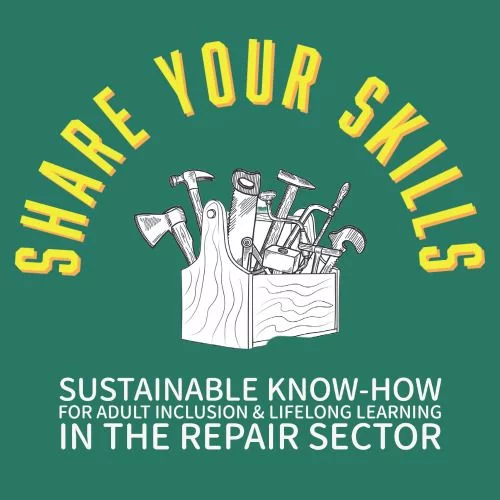
Erasmus+ – Share your skills Skills for Repair, Recovery and Recycling in the Context of Ecological Transition
Valorizing informal repair skills to support lifelong learning, ecological transition and inclusive societies
Programme: Erasmus+ – Adult Education Project code: 2021-1-FR01-KA220-ADU-000026628 Duration: 2 years (from 2021) Lead partner: France Focus: Skills in the repair sector, ecological and digital transition, lifelong learning
Project Overview
Share Your Skills is an Erasmus+ project for adult education, funded by the European Commission for a duration of two years. The project focuses on the repair sector as a testing ground for developing and strengthening technical and transversal skills—both formal and informal—for adults. Drawing inspiration from successful experiences across Europe—such as the “Repair Cafés” widely established in France and Germany and growing in Italy as well—the project explores how repair skills can be integrated into lifelong learning pathways. The objective is to support ecological and digital transition while fostering more inclusive and participatory societies.
Objectives
Raise awareness among communities about the importance of sustainable behaviors and the challenges of ecological and digital transition in the repair sector
Identify, develop and valorize repair, recovery and recycling skills in formal and informal learning contexts
Develop and promote skills within a lifelong learning framework, making informal repair skills visible and transferable
Identify and characterize beneficiaries in the repair sector and understand their diverse needs
Implementation
The project uses innovative experiences such as Repair Cafés as learning environments, analyzing the skills practiced informally in these community spaces. It develops a skills passport to make transparent and portable the competencies acquired by adults through informal repair activities. A training toolkit on recovery, repair and recycling themes is also created and tested in partner countries.
Expected Results
Greater awareness among target groups and partners of the challenges of ecological and digital transition in the repair sector
A skills passport for transparency and recognition of repair, recovery and recycling competencies acquired informally
A training toolkit for adult education on recovery, repair and recycling
A stronger link between informal learning in the repair sector and formal lifelong learning pathways
Share Your Skills places repair at the heart of lifelong learning, transforming everyday sustainability practices into recognized pathways for adult education and social inclusion.
Upgrading construction sector skills through Virtual Reality, immersive design and Key Enabling Technologies
Programme: Erasmus+ Sector: Construction, Architecture, Built Heritage Technologies: VR, Immersive Interactive Experience (IIE), advanced 3D modelling, KETs Target Audience: Students, universities, architects, engineers, construction specialists, educational organisations
Project Overview
ID4Ex (Immersive Design for Excellence) addresses the Europe 2030 strategy priorities on employment and education, responding to the insufficient supply of quality digital content for training in the construction sector. The construction industry faces major challenges — accelerated by the health emergency — that require a fundamental rethinking of spaces, supply chains and training approaches. In this context, digitisation represents an important driver for innovation, effectiveness and excellence. ID4Ex promotes an inclusive, immersive approach to project design that combines Virtual Reality, Immersive Interactive Experience (IIE), advanced 3D modelling and Key Enabling Technologies (KETs) to upgrade skills in built heritage intervention.
Objectives
Upgrade and innovate existing training programmes with up-to-date Immersive Design methods for built heritage interventions
Improve the effectiveness of teaching and learning through an inclusive, immersive design approach
Increase the synergic use of up-to-date technologies (VR, IIE, 3D modelling) in an integrated team-based approach
Strengthen cooperation among educational institutions and enterprises in the EU for better graduate employability
Implementation
ID4Ex develops a comparative research study on VR technologies for rehabilitation and valorisation of built heritage, alongside training modules for immersive design experts and a digital training toolkit. The project primarily targets students and universities but also engages practising architects, engineers, construction specialists and educational organisations, ensuring that new immersive competences are embedded across the construction education ecosystem.
Expected Results
Comparative research on Virtual Reality applications for built heritage rehabilitation and valorisation
Training modules for immersive design experts in the construction sector
Digital training toolkit for immersive design professionals
Enhanced cooperation networks between educational institutions and construction enterprises
ID4Ex brings immersive technology to the heart of construction education, enabling a new generation of professionals to design and preserve built heritage with cutting-edge tools.
BIM 4 Placement BIM4PLACEMENT – European Key Competences in Building and Construction
Building a bridge between Northern and Southern Europe through Building Information Modelling
Programme: Erasmus+ KA2 – VET Strategic Partnerships Project Code: 2016-1-IT01-KA202-005399 Duration: Concluded Countries: Italy, Finland, Norway, United Kingdom Lead Organisation: Centoform Srl, Italy Partners: Oulun Yliopisto (FI), Viasys Vdc Oy (FI), Regione Emilia-Romagna (IT), Universitetet I Stavanger (NO), AEEBC Ltd (UK)
Project Overview
Building Information Modelling (BIM) is a process involving the generation and management of digital representations of physical and functional characteristics of buildings and infrastructures. While BIM is well established in northern Europe — Finland and Norway have been among the earliest adopters — awareness and implementation in southern Europe, particularly Italy, lagged significantly behind. BIM 4 Placement was a capacity-building Erasmus+ project that set out to bridge this gap through transnational cooperation among six organisations across Italy, Finland, Norway and the UK. The project promoted BIM as a training subject for employability, upgrading qualifications and creating a network for work-based learning.
Objectives
Deepen knowledge about BIM as a skills-development training subject for employability goals
Build a transnational bridge between northern and southern European BIM practices and expertise
Upgrade existing training tools and professional qualifications in the building and construction sector
Create a VET network to promote work-based learning around BIM
Implementation
The project brought together six organisations — VET providers, regional authorities, universities and an EU association — from three countries. Partners conducted intensive transnational training courses to exchange best practices in BIM training and implementation, alongside local training events for trainers, teachers and students in the building sector. A new serious game about BIM was developed for beginners, and a comparative research study was produced.
Expected Results
Comparative research publication: “BIM as Driver for Innovation and Employment”
New and renewed professional qualification in building and construction for Emilia-Romagna Region
New and updated training programmes about BIM for students, unemployed and employed professionals
New BIM serious game for beginners
BIM network connecting educational institutions and companies for work-based learningRete BIM che collega istituzioni educative e aziende per il work-based learning
BIM 4 Placement ha accelerato l’adozione del Building Information Modelling in Europa, aprendo la strada ai paesi del sud Europa verso i livelli di implementazione dei loro omologhi del nord.
TICHE Project Training & Innovation in Circular Economy per l’Alta Formazione Professionale
Establishing a European VET Academy on Circular Economy through transnational ecosystem cooperation
Programma: Erasmus+ Focus: Competenze verdi, economia circolare, capacity building VET Partnership:Research centres, VET centres, universities, SMEs, clusters, umbrella organisations, public administrations Vision: A European Training Area for Circular Economy
Project Overview
Climate change and the imperative shift away from the linear economy paradigm demand a fundamental rethinking of skills in the workforce. The TICHE Project responds to this need by establishing a European VET Academy on Circular Economy, driven by a highly experienced and complementary transnational partnership. The project is grounded in the recognition that “green jobs” — expected to represent more than 80% of jobs by 2030 — require not just compositional skill changes but a substantial shift in skills domains. TICHE addresses both the growing demand for green-skilled workers and the need for entrepreneurs with a “green mindset”, aligning with Smart Specialization Strategies across all partner countries.
Objectives
Establish a European VET Academy on Circular Economy as a lasting transnational structure for green skills development
Develop a comprehensive green skills framework tailored to the circular economy needs of each partner territory
Build the capacity and responsiveness of VET systems to address the demands of a low-carbon economy
Support the transition to bio-based, low-impact and sustainable production across different sectors
Implementation
TICHE operates as an ecosystem bringing together research centres, VET centres, universities, SMEs, clusters, umbrella organisations, international networks and public administrations. This diverse consortium works collaboratively to build capacity and produce transferable resources that strengthen the responsiveness of VET systems across Europe, in line with the concept of a European Training Area. Partner engagement covers the entire circular economy innovation chain, from research and curriculum design to piloting and dissemination.
Expected Results
A European VET Academy on Circular Economy operational across partner countries
A green skills curriculum framework adaptable to different sectors and territorial contexts
Strengthened VET system capacity to respond to green transition demands
Policy recommendations aligned with Smart Specialization Strategies in partner countries
A transnational ecosystem connecting research, education, business and public administration
TICHE builds the foundations of a European green skills ecosystem, enabling VET systems to become the driving force of the circular economy transition.
Life ADA Agriculture and Climate Change Adaptation
Building climate resilience across three agri-food supply chains in Emilia-Romagna
Programme: LIFE – EU Programme for Environment and Climate Action Period: October 2021 – June 2022 Territory: Emilia-Romagna Region, Italy Supply Chains: Fruit & Vegetables, Viticulture, Dairy – Parmigiano Reggiano Target Participants: 50 farmers and producer organisation members Contact: Elena Zani | elena.zani@centoform.it | 051 68 30 470
Project Overview
Life ADA aims to build robust climate resilience objectives along three key agri-food supply chains in the Emilia-Romagna region: the dairy sector (Parmigiano Reggiano), viticulture and fruit and vegetable production. The project delivers a structured training and awareness programme for farmers, producer organisations and sector operators. Through a series of technical webinars and good practice exchange workshops, Life ADA provides concrete, sector-specific knowledge on climate change impacts, risk management, adaptation strategies and new digital tools applied to agriculture.
Objectives
Provide farmers with up-to-date knowledge on climate change, its projections and impacts on agriculture
Share adaptation strategies and tools specific to each of the three supply chains (dairy, viticulture, fruit & vegetables)
Facilitate knowledge exchange and good practice sharing among operators from the three sectors
Facilitate knowledge exchange and good practice sharing among operators from the three sectors
Implementation
The programme delivers 9 webinars — 6 technical and 3 dedicated to good practice exchange — plus in-company study visits. Activities are supported by a facilitator-tutor figure ensuring pedagogical quality and participant engagement. Topics range from climate projections and big data in agriculture to sector-specific economic impacts and adaptation tools for Parmigiano Reggiano, viticulture and fruit & vegetable production.
Expected Results
50 trained farmers and producer organisation members across three supply chains
Good practice exchange among best-in-class companies in the Emilia-Romagna agri-food sector
Increased capacity of operators to implement climate adaptation measures in their enterprises
Life ADA equips Emilia-Romagna’s agricultural operators with the knowledge and tools to build climate resilience and secure the future of their supply chains.
EDURES Technology Education in the Digital Age Supported by the Meaningful Use of Research Results
A three-year international project to integrate research findings into tertiary technical education
Program: Erasmus+ KA2 Duration: 3 years (September 2020 – September 2023) Lead partner: Rzeszow University of Technology – Poland Partners: National Technical University of Athens (GR), Furtwangen University (DE), Centoform Srl (IT) Reference fields: Mechanical engineering, civil/construction engineering
Project Overview
EDURES addresses a concrete need in tertiary education: research findings are being used insufficiently and inappropriately in teaching at university and higher technical education levels. The project brings together three universities and a VET center from Poland, Greece, Germany, and Italy in an international, interdisciplinary collaboration to design methodologies, digital tools, and teaching resources that integrate research findings into engineering education.
Objectives
Developing a teaching guide for teachers and trainers on the use of research findings in tertiary and higher technical education
Designing methodologies for a digital platform to support the constructive use of research findings
Create pilot lessons using the methodologies developed in the EDURES project
Create and populate a digital platform with the educational content developed in the project
Produce a final report on continuous improvement tools, procedures and techniques
Implementation
The four partner organizations work collaboratively to produce five intellectual outputs over three years. Centoform participates as a VET partner, ensuring that the outputs are applicable not only at university level but also in higher vocational training (IFTS/ITS). The project adopts interdisciplinary approaches in mechanical and civil/building engineering, linking academic research with practical teaching needs.
Expected Results
A teaching guide for integrating research findings into tertiary and technical education
Methodologies and specifications for a dedicated digital platform
A set of pilot lessons validated at partner institutions
A functional digital platform with research-based educational content
A final report on tools, procedures, and continuous improvement for integrated research education
EDURES bridges the gap between research and teaching, ensuring that the most up-to-date engineering knowledge reaches students at universities and technical institutes across Europe.
DIG-MAN Digital Tools Integration in Product Development and Manufacturing Education
An Erasmus+ KA2 project creating innovative e-learning tools for the manufacturing sector
Programme: Erasmus+ KA2 – Cooperation for Innovation and Exchange of Good Practices Lead Partner: Estonian University of Life Sciences Partners: University of Stavanger (NO), Rzeszow University of Technology (PL), Kaunas University of Technology (LT), Centoform Srl (IT) Countries: Estonia, Norway, Poland, Lithuania, Italy
Project Overview
DIG-MAN is an Erasmus+ KA2 project for cooperation for innovation and the exchange of good practices. Through international partnership, the project provides a new innovative tool for e-learning in the manufacturing sector. The main goal is to enhance knowledge concerning the utilisation of digital manufacturing tools at the higher education level, creating learning materials that are universally adaptable across IFTS, ITS, universities and VET institutions. DIG-MAN addresses local and European challenges such as youth unemployment, low-skills training gaps and the evolving demands of digital manufacturing technology. Using an open-source philosophy, the project complements existing training tools and positions universities, VET agencies and companies as active actors in EU socio-economic development.
Objectives
Enhance knowledge and skills in digital manufacturing tools at higher education and VET level
Create universally adaptable e-learning materials for students and practitioners across multiple disciplines
Address youth unemployment and skills gaps through innovative digital training solutions
Promote an open-source philosophy to complement existing institutional training tools
Implementation
DIG-MAN develops three complementary intellectual outputs: a Didactic ProDeM Guide for educators, an Integrated Digital Workbook for students, and interactive e-learning materials for 12 selected product development courses. The tools are effective, internationally validated, portable and flexible for different beneficiaries. Dissemination takes place through the project website, stakeholder involvement from the outset, and participation in conferences and summer schools across Europe.
Expected Results
Output 1: Didactic ProDeM Guide – a reference manual for educators on digital manufacturing pedagogy
Output 2: Integrated Digital Workbook – a practical tool for students
Output 3: Interactive e-learning modules for 12 selected product development courses
Validated materials adaptable to IFTS, ITS, university and VET contexts across Europe
DIG-MAN delivers open, adaptable digital tools that bring manufacturing education into the 21st century across five European countries.
SMART&STEAM VET — Guidance Strategies in the Digital Age
Serious gaming for SMART educational choices — a cross-sectoral Erasmus+ KA2 project
Programme: Erasmus+ KA2 – Strategic Partnerships (cross-sector: VET and School Education) Duration: 24 months (November 2019 – October 2021) Lead Partner: Colegiul Tehnic “Cibinium” – Romania Partners: OEIBF (AT), CIFP Valle de Elda (ES), ZEPSOL School (PL), Melazeta Srl (IT), Centoform Srl (IT) Countries: Romania, Austria, Spain, Poland, Italy
Project Overview
SMART&STEAM VET is an Erasmus+ KA2 Strategic Partnership project focused on the attractiveness of vocational training, professional development and social inclusion across five European countries. The project addresses key issues related to the attractiveness of VET in the digital age, professional development and gender equality in STEAM subjects and technical culture. Using Serious Gaming as the core methodology, the project aims to create transferable guidance tools for VET teachers, trainers and tutors, and to develop strategies for effective VET-business cooperation. It also addresses early school leaving and gender stereotypes related to STEAM disciplines — subjects increasingly in demand by the labour market.
Objectives
Create a transferable Serious Learning Game for the professional skills development of VET professionals in guidance activities
Develop new strategies for effective VET-business cooperation by involving complementary stakeholders
Address the lack of innovation in guidance tools available in schools and VET centres
Reduce early school leaving and combat gender stereotypes in STEAM subjects
Implementation
The project delivers two joint transnational staff training events and five local multiplier events. Two new digital intellectual outputs are produced, disseminated through the European Skills Week events. A combination of complementary partners — three VET organisations, a VET research institute and a gamification company — work together to create effective guidance messages for students, families, schools and policymakers. The dissemination reaches at least 2,500 beneficiaries through outreach activities.
Expected Results
A Serious Learning Game on guidance for SMART educational and professional choices
Training materials and webinars for VET professionals in guidance activities
Policy recommendations for VET-business cooperation and inclusion in educational systems
Greater awareness of gender issues related to STEAM subjects among students, families and schools
SMART&STEAM VET transforms vocational guidance into an engaging and inclusive digital experience that helps young people make informed choices for their future.
DIAGNOSIS Innovating a Crucial Profession in Building and Construction Sector
Creating the “Diagnostic Expert” — a new professional profile for building assessment using up-to-date technologies
Programma: Erasmus+ KA2 – Partenariati Strategici per la VET Project Number: 2017-1-ES01-KA203-038254 Duration: 2 years (November 2017 – October 2019) Lead Partner: Asociación RehabiMed – Spain
DIAGNOSIS addresses a significant gap in the building and construction sector: the absence of a specialised professional profile capable of performing up-to-date building assessments. This Diagnostic Expert must be able to dialogue with building owners, administrators and construction professionals, using advanced technologies to analyse buildings and identify the interventions needed — for earthquake prevention, energy improvement, structural safety and environmental comfort. Financed under Erasmus+ KA2 Strategic Partnerships, the project brings together seven organisations from Spain, Italy, the UK and Poland to deepen knowledge about existing diagnostic technologies and upgrade training tools and professional qualification curricula.
Objectives
Define and validate a new “Diagnostic Expert” professional profile for the building and construction sector
Upgrade existing training tools and professional qualification curricula to include up-to-date diagnostic technologies
Promote the use of advanced diagnostic tools: BIM, Geomatics, remote sensing, 3D modelling and ICT
Consolidate the Diagnostic Expert profile as a specialisation in the rehabilitation of local and cultural heritage
Implementation
The project consortium of seven organisations collaborates on research, curriculum design and professional qualification development. Centoform and the University of Ferrara’s Department of Architecture contribute the Italian perspective, while Asociación RehabiMed (ES) leads the project and drives dissemination across the Euro-Mediterranean university world. The desired professional profile encompasses competences in structural, energy and environmental diagnostic tools alongside communication and cross-disciplinary skills.
Expected Results
A validated “Diagnostic Expert” professional profile with a defined competence framework
Updated training curricula and professional qualification materials for building diagnostics
A consolidated expert community at Euro-Mediterranean level in building rehabilitation
Enhanced use of cutting-edge diagnostic technologies (BIM, Geomatics, 3D models) in the sector
DIAGNOSIS creates a recognised, technically equipped professional profile that bridges the gap between building science and real-world decision-making for owners and managers.
You can accept, reject, or customize the cookies by clicking the desired buttons.
By closing this notice, you will continue without accepting.
By accepting, you acknowledge that your personal data may be collected for the purpose of personalizing and measuring the effectiveness of advertising.
Google Analytics è un servizio di analisi web fornito da Google Ireland Limited (“Google”). Google utilizza i dati personali raccolti per tracciare ed esaminare l’uso di questo sito web, compilare report sulle sue attività e condividerli con gli altri servizi sviluppati da Google. Google può utilizzare i tuoi dati personali per contestualizzare e personalizzare gli annunci del proprio network pubblicitario. Questa integrazione di Google Analytics rende anonimo il tuo indirizzo IP. I dati inviati vengono collezionati per gli scopi di personalizzazione dell'esperienza e il tracciamento statistico. Trovi maggiori informazioni alla pagina "Ulteriori informazioni sulla modalità di trattamento delle informazioni personali da parte di Google".
Facebook Remarketing è un servizio di Remarketing e Behavioral Targeting fornito da Facebook Ireland Ltd. Questo servizio è usato per collegare l'attività di questo sito web con il network di advertising Facebook.
Google Fonts è un servizio per visualizzare gli stili dei caratteri di scrittura gestito da Google Ireland Limited e serve ad integrare tali contenuti all’interno delle proprie pagine.
Il monitoraggio conversioni di LinkedIn (LinkedIn Insight Tag) è un servizio di statistiche e di targeting comportamentale fornito da LinkedIn Corporation che collega i dati provenienti dal network di annunci LinkedIn con le azioni compiute all'interno di questo Sito Web.
Il monitoraggio per le conversioni di Google Ads è un servizio di statistiche fornito da Google Inc. che viene usato per inviare i dati delle azioni compiute all'interno di questo Sito web.